After a few months offline due to technical issues, the blog is back up and running. I will be uploading a new post in the next few days.
Emily Lauterpacht
Monday, 10 August 2015

Thursday, 14 May 2015
Nepal Earthquakes by Emily Lauterpacht
On Saturday 25th April, an earthquake of magnitude 7.9 hit Nepal, killing over 8000 people. On Tuesday 12th May a second earthquake of magnitude 7.3 hit Nepal, just over 2 weeks after the initial quake.
I wrote an article (read it here) the day the first earthquake hit Nepal. Since then the death toll has risen to over 8000. We now know that the focus of the earthquake was about 15 km deep (considered shallow and is likely to cause more damage than an earthquake with a deeper focus), lasted about 20 seconds, and nearly 18000 people were injured.
There were 41 aftershocks between the 25th and 27th April, with magnitudes ranging between 4.0 and 6.6. It is normal to experience aftershocks in the days after a large earthquake, with the magnitude of these earthquakes normally decreasing as time passes after the initial quake. What is not so normal, is what followed last Tuesday.
On 12th May, a 7.3 magnitude earthquake occurred. With another shallow focus (18.5 km deep), the tremors were felt up to 2500 km away. Just a few minutes later, an aftershock of magnitude 6.3 followed, which could be felt as far away as New Delhi, India. The death toll of this quake is now above 100 people, and is still slowly rising.
So what has caused all of these earthquakes?
Nepal lies on a boundary between two tectonic plates: the Indian Plate and Eurasian Plate. The collision of these two plates caused the formation of the Himalayas 50 million years ago (see picture below). The two plates are still moving towards each other, at about 45mm a year. When plates are moving towards or along side each other, they sometimes stick, and pressure builds up, as the convection currents in the mantle below move. Eventually this pressure is released in a series of earthquakes.
While the earthquake on 12th May was a lot larger and later than aftershocks of the earthquake on 25th April would have been expected, it is still considered an aftershock as they occurred on the same fault, although the original earthquake was further west than the one that followed last Tuesday.
What can you do to help?
After the first quake, Rugby School sent many tents and sleeping bags out to Nepal (see picture below), and all the pupils are making donations today, following the second quake, which will be put together and sent off.
A quick google search comes up with many different ways that you can donate to help the people of Nepal, but The Guardian have summarised most of the ways here.
 |
| Formation of the Himalayas |
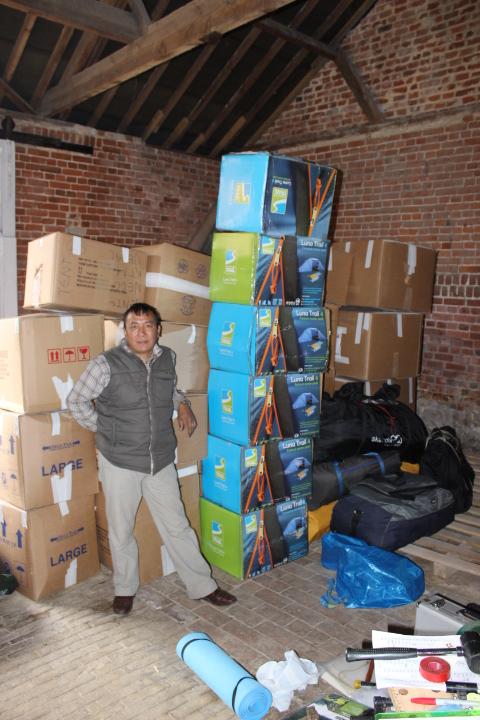 |
| The tents and sleeping bags donated by Rugby School, all boxed up, ready to be sent to Nepal |
Emily Lauterpacht
Saturday, 25 April 2015
Chile Volcano and Nepal Earthquake by Emily Lauterpacht
On Wednesday 22nd April, the volcano Calbuco in Chile unexpectedly erupted after being dormant since 1972. This has been followed by an earthquake of magnitude 7.9 that Nepal today (25th April).
Just like the eruption Iceland's volcano, Eyjafjallajökull, in 2010, Calbuco's eruption has disrupted many international flights, due to the ash cloud created, that went 20km into the air. This ash is now blanketing villages in Argentina and southern Chile, and there are worries that more ash could spread even further afield if Calbuco continues to erupt.
Fortunately no injuries have been reported, but many villages have been evacuated (4000 people). Farmers are struggling the most, as there is nowhere to graze their animals.
Footage of the eruption
Just 10 hours after the earthquake in Nepal, the death toll has already exceeded 900, and is still quickly rising. At least 634 of these people were in the Kathmandu Valley, 300 more in Nepal's capital Kathmandu, 36 in India, 12 in China, 4 in Bangladesh and 6 in Tibet.
Along with the usual effects of an earthquake, an avalanche was triggered on Mount Everest, killing at least 18 and trapping many more. It also damaged Everest base camp. The historic Dharahara Tower collapsed during the earthquake.
This is the greatest magnitude earthquake to hit Nepal in over 80 years. It is thought that the earthquake's focus was not very deep underground, increasing the force felt. There have also been at least 12 aftershocks, one of which had a magnitude of 6.6.
 |
| Dharahara Tower before the earthquake |
 |
| Dharahara Tower after the earthquake |
Emily Lauterpacht
Tuesday, 17 March 2015
A Trip To Oxford University by Emily Lauterpacht
On Wednesday, 11th February, a group of pupils and teachers from Rugby School travelled to Oxford to visit the famous university’s Natural History Museum. I have reviewed our day out for the school science magazine.
We arrived in Oxford just before lunch time, so after a brief lunch break we headed to Oxford University's Natural History Museum. We were ushered into a large lecture theatre, hidden away upstairs, by one of the museum's education officers, who spoke to us about the theory of evolution. During this talk, we learnt that Charles
Darwin’s favourite animal was the barnacle and were allowed to pass round
various taxidermy animals. However, my personal highlight was when a tank of Madagascar
hissing cockroaches where pulled out from behind the desk, and we were then
offered the opportunity to hold them. The squeals of excitement from some only
added to the comedy of the looks of pure disgust on the faces of others. Unfortunately,
all too soon, it was time to return Jemima (the name that a few of us had given
to our cockroach). After more information on the topics relevant to our AS course, we were taken upstairs to a long, narrow room, which housed
thousands of invertebrates in wooden cabinets. This room was the location of
the “Great Debate”, in 1860. This event saw a clash between Thomas Henry
Huxley, a great believer in the concept of evolution, and Samuel Wilberforce,
Bishop of Oxford and an absolute creationist. You can read more about the "Great Debate" here.
We were then given time to wander around the museum, with a
booklet, to help us relate our trip to the relevant parts of our AS course.
Along with the invertebrates that we had seen upstairs, the museum is home to
thousands of other creatures. The biggest of these welcomes you as you first
enter the museum; “Stan” is the cast of a Tyrannosaurus rex skeleton, and is a
massive 12m long. The museum also houses many other skeletons, including a
polar bear, a horse, an ostrich and various other dinosaurs. As well as
skeletons, the museum has various animals which have been stuffed, such as a
penguin, a koala and a dodo.
Following our trip to the museum, one of the teachers had organised
for us to visit biological sciences department at Oxford University. Professor
Martin Speight, one of the professors of zoology there, spoke to us about the
“value added” areas at Oxford University, such as Wytham Wood and their Botanic
garden. We were then told about the modules that made up the biological
sciences course, and some of the different research and the trips involved,
including one to Borneo to study rainforest ecology. He finished his talk by discussing
about the application process. We were then given a tour of the zoology department,
where we were shown various labs and some other facilities that they have
there.
Emily Lauterpacht
Wednesday, 11 March 2015
Articles from the past few days by Emily Lauterpacht
While these stories may not have been the most pressing issues in the news over the past few days, they are stories that I have enjoyed and found interesting. I have explained a little about them, and added links to more information on them. These articles all have a water theme to them.
We often forget how vast the oceans are - did you know they make up 99% of the planet's living space? We often therefore fail to realize how much more there is left to explore under the sea. This article tells about how many of the 225000 known species that are found in the ocean are under threat.
The website "Views of the World" uses distorted maps to present data relating to various articles. I came across this article when looking at webpages relating to my first blog post. It looks at the ocean chlorophyll levels and how levels increase near land.
We are currently studying biodiversity in my biology lessons, and I found this article about the beavers in the UK, when doing some extra research on the topic. Here is Devon Wildlife Trust's website, which explains more about them, including recent news, and other information.
Finally, here is a short clip from National Geographic's website to brighten your day.
Emily Lauterpacht
Wednesday, 4 March 2015
Articles from the past few days by Emily Lauterpacht
While these stories may not have been the most pressing issues in the news over the past few days, they are stories that I have enjoyed and found interesting. I have explained a little about them, and added links to more information on them.
Scientists have unearthed a lower jaw bone and 5 teeth belonging to what they think is one of the very first humans. The fossil was found on a hillside in Ethiopia, and is the oldest remains ever found belonging to the genus Homo. You can read more about it here.An image of a weasel riding a woodpecker whilst in flight has been circulating the internet over the last few days. However, there is much debate over the authenticity of it. National Geographic have looked at the likelihood of this photo being real here.
Emily Lauterpacht
Monday, 2 March 2015
Chlorophyll, The Heart of Natural Solar Power by Emily Lauterpacht
This is a slightly adapted version of an article that I wrote for the school science magazine last year. It is titled "Chlorophyll, The Heart of Natural Solar Power".
The word chlorophyll derives from Greek; chloros, meaning
green and phyllon, meaning leaf. It is the pigment in leaves that makes them
green. Its main purpose is to act as a catalyst in photosynthesis, the reaction
that turns water and carbon dioxide into glucose and oxygen using energy from
the sun. Chlorophyll was first isolated by Joseph Bienaimé Caventou and Pierre
Joseph Pelletier in 1817. It is made up of carbon, hydrogen, oxygen, nitrogen
and magnesium in different proportions, depending on the type of chlorophyll.
There are two main types of chlorophyll, type a and type b. They are very similar, but a variation
in a side chain of the molecule, normally represented by an R in any diagrams,
allows them to “tune” into slightly different parts of the visible light
spectrum (the R group of chlorophyll a is CH3, and of chlorophyll b
is CHO). The main function of the
chlorophyll found in leaves is to absorb sunlight, at an efficiency of about
1-2%. This energy is then transferred to a chlorophyll molecule. This absorbed
energy excites an electron in the chlorophyll to a higher energy state, meaning
it is more easily transferred to carbon dioxide. The electron that the
chlorophyll loses is replaced by one from water. Over twenty steps then occur
without chlorophyll, called dark reactions, before the glucose is produced.
Interestingly, a type of green sea slug, Elysia
chlorotica, has evolved so that it uses the chlorophyll it eats from algae
to perform photosynthesis itself. This is the only animal known to perform this
process, called kleptoplasty. The earth absorbs roughly 89 petawatts (1
petawatt = 1 x 10¹⁵watt) of energy from the Sun per year. Humans meanwhile only
use about 0.016 petawatts a year, and so if we could find an economical way of
harnessing just 0.02% of the energy from the sun, we would have a “free”, green
energy source, easily able to cope with the growing energy demands of humans. Solar
panels are often used now to generate electricity, but since they do not work
at night, they prove problematic. Scientists are also working to increase their
efficiency from the ~15% that it is now. Finding a way to mimic photosynthesis
would mean that we could start to reduce the amount of greenhouse gases in the
atmosphere, instead of adding to them, which is a concern for many scientists
around the globe. In recent years, leading scientists have developed ways of
making fuel directly from sunlight, but this has involved very expensive
catalysts, such as platinum, and the cells used have been nowhere near robust
enough to be used outside in unpredictable weather conditions all year round.
Professor Daniel Nocera and his colleagues have been perfecting using other
catalysts, such as cobalt based compounds and a nickel-molybdenum-zinc alloy,
to use the sun’s energy to convert water into hydrogen and oxygen. The hydrogen
can then be used as a fuel, and although this would not remove greenhouse gases
from the atmosphere, it wouldn’t create more either. You can find a video
Professor Nocera’s cells working here. These new cells are cheaper as the catalysts are very abundant on
earth, and the cells can be formed by self-assembly, so are easy to
manufacture. They are also more durable and the hope is that it will soon be
possible to economically produce large quantities.
The BBC program Horizons reported on Dr Nocera's artificial leaves in 2013, and can be watched here.
Emily Lauterpacht
Emily Lauterpacht
Subscribe to:
Posts (Atom)